Creating a Green Innovation Hub
Grand Green Osaka is a new model of landscape-led urban development, where a former freight yard has been transformed into a dense mix of parkland, innovation enterprises, commercial and residential programs. Positioned as both a civic green and a driver of economic ambition, the project raises a larger question: can privately led developments truly deliver public space in contemporary Japanese cities?
JapanStory Team with contributions from Takenaka Corporation
Grand Green Osaka (GGO) is a recent landscape-based urban development at the center of Osaka which opened to the public on September 6, 2024. By all accounts, the large-scale project, parts of which are still under construction, has been a great success. During its first three days, Grand Green attracted over 500,000 visitors. It’s the first project that can seriously compete with many of Tokyo’s more recent mega mixed-use developments. An earlier phase of the project, Grand Front Osaka (GFO), opened in 2013.
The area commonly known as “Umekita” lies directly north of the JR Osaka Station. The site was once a freight yard but had long been considered as the last prime site for development in central Osaka. It provided a unique opportunity for something different beyond the norms of mixed-use projects.
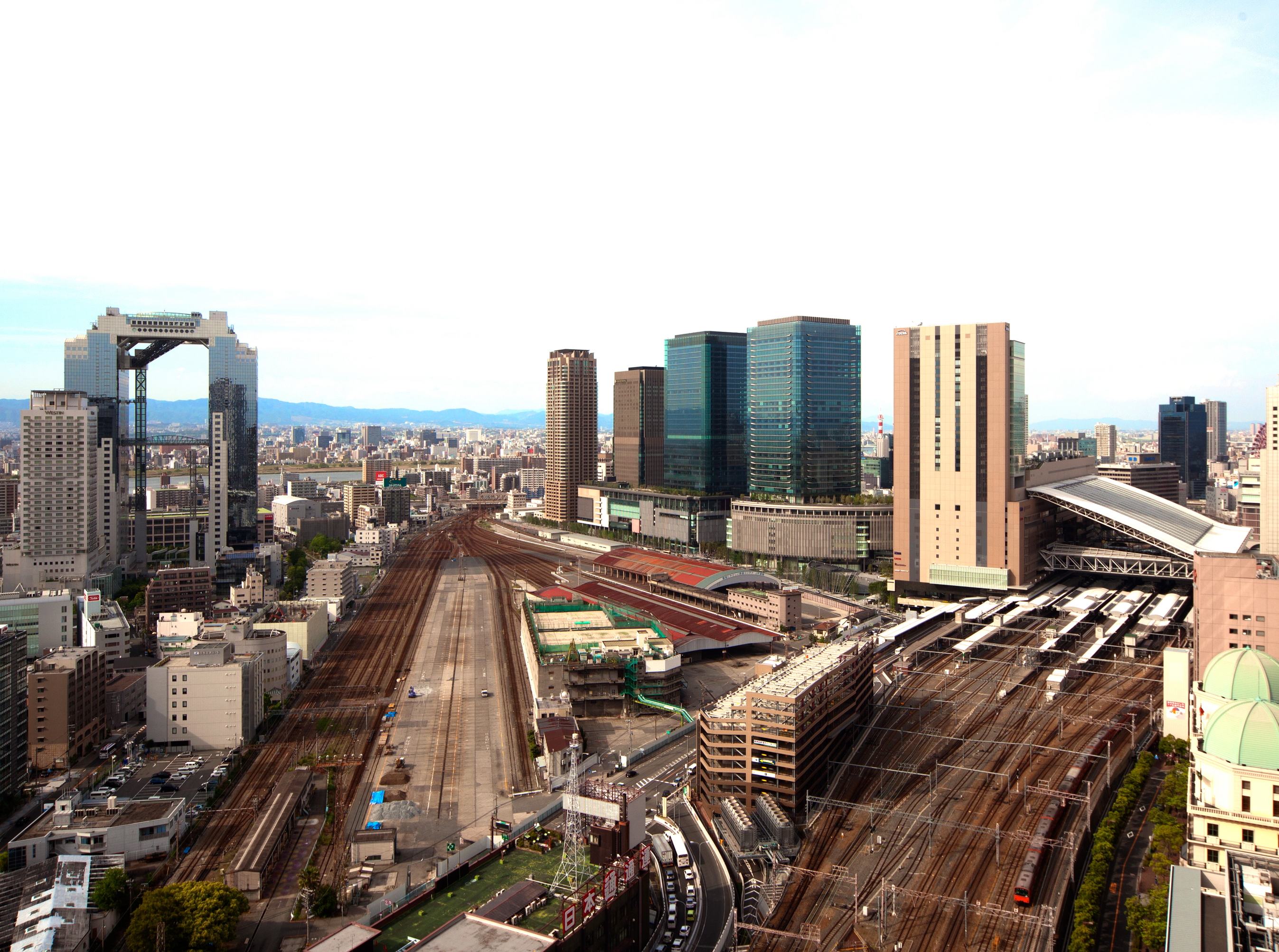
Former Umekita freight yard, 2013.
Grand Green has three distinct characteristics. The first is the overall vision of the project as a “creative hub that generates new industries, technologies, culture, and values to be transmitted from Kansai to the world.”1 This aspirational agenda for Osaka’s global competitiveness was devised by a special partnership formed between government agencies, academia, and industry.
The second relates to its reliance on landscape as the primary conceptual organizer. In other large-scale developments like Tokyo Mid-Town, landscape, while important, is not the primary driver of the design. At Grand Green, the landscape designed by Kathryn Gustafson and her partners at GGN lies at the heart of the development, holding everything else around it.
The green space, known as Umekita Park, constitutes more than half of the total 9.1-hectar development area. As a result, the project provides a much-needed public green space for all Osakans, or Osaka-jin in Japanese, to enjoy. The park also fuses the boundary between greenery and building by creating more porous conditions between the two.
Private development parcels lie to the north and south, comprising of offices, three hotels, commercial facilities, two residential towers, and the innovation complex JAM BASE. The built area totals to approximately 550,000 square meters. JAM BASE functions as a hub for creativity – incorporating co-working zones, collaboration spaces, and small offices, for interdisciplinary exchange.
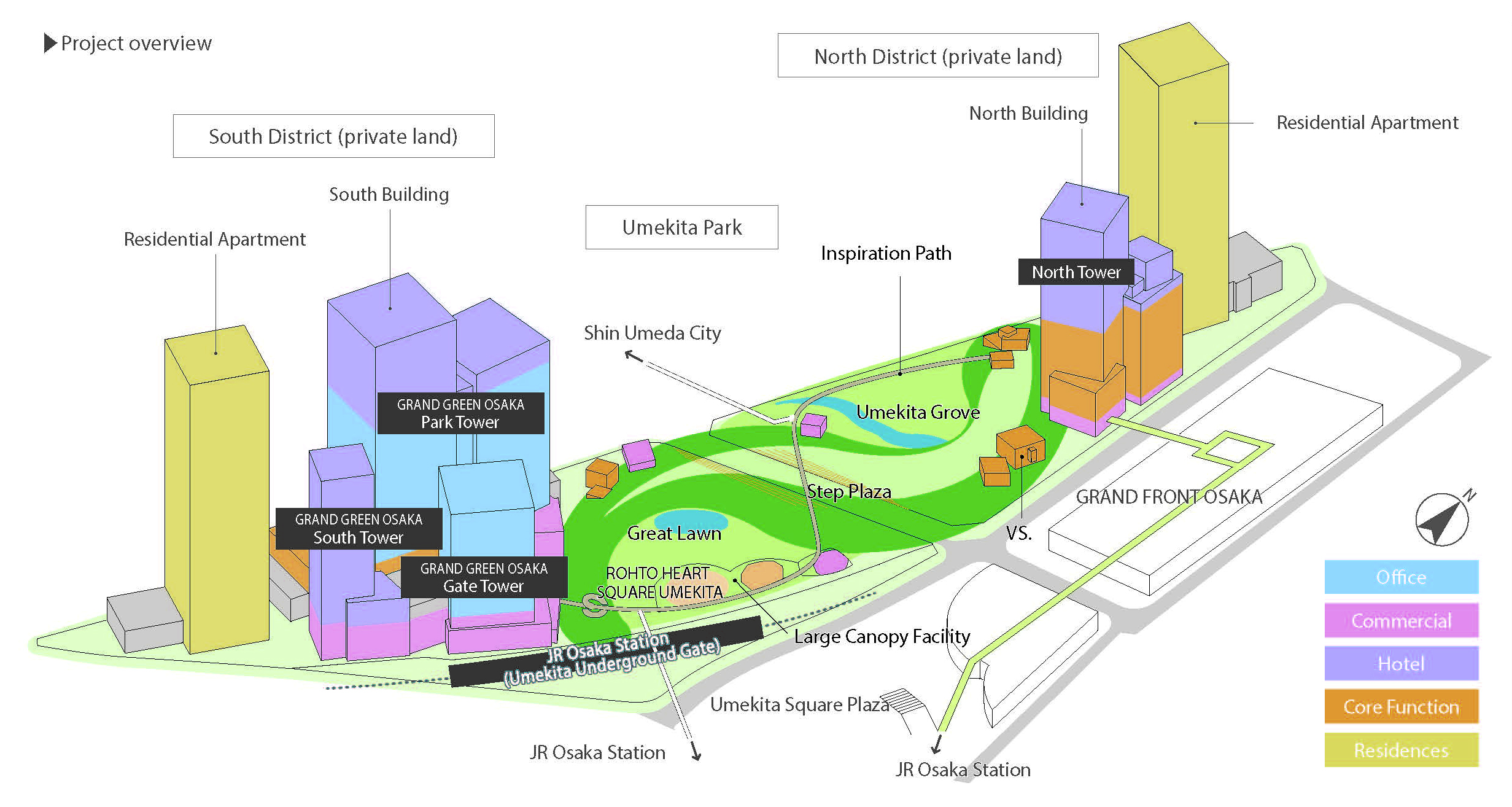
Axonometric diagram of GGO’s programmatic distribution.
The third unconventional characteristic of GGO is the collaboration of nine companies that came together as a private-public partnership to realize this scheme. This venture, led by Mitsubishi Estate, includes Takenaka Corporation, responsible for several of the large buildings, as well as Osaka Gas Urban Development, ORIX Real Estate, Kanden Realty & Development, Sekisui House, Hankyu Corporation, Mitsubishi Estate Residence, and Umekita Development Specific Purpose Company. These companies were additionally joined by several government departments, namely the Urban Renaissance Agency, the city of Osaka, and Osaka Prefecture. Nikken Sekkei and Mitsubishi Jisho Design, two of Japan’s largest architectural practices, led a large group of design consultants.
Such large developments typically feature a few signature architects for certain highly visible components and Grand Green is no exception. One of the centerpieces of GGO is the Large Canopy, a free form thin-shell pavilion at the edge of the park designed for public events by SANAA. The structural engineer for the project was Mitsuhiro Kanada. There is also a cultural facility, knows as VS to the north of the development by Tadao Ando, who is an Osaka local. The space was the venue for a major exhibition of his work called “Youth” in 2025.
Overall view of Grand Green Osaka, with SANAA’s Umekita Canopy in the foreground, 2024. Courtesy of Akira Ito.
Grand Green is a lively and dynamic new addition to the skyline of Osaka. Its emphasis on both open space and innovation distinguishes it from many earlier examples of private development. This substantial piece of public greenery under private stewardship is a particularly welcomed contribution to the city and its citizens. Still, this privately owned public space is, at least for now, periodically closed for lawn maintenance and recovery. Such restrictions may be necessary, yet they raise broader questions about how public access is negotiated and managed within contemporary privately operated open spaces. Still, this privately owned public space is, at least for now, periodically closed for lawn maintenance and recovery. Such restrictions may be necessary, yet they raise broader questions about how public access is negotiated and managed within contemporary privately operated open spaces.
Will it be possible for Osaka and other major Japanese cities to create authentically green and public spaces? What are ways to disentangle the regulatory and monitoring techniques of control typically associated with privately owned public spaces? How can the public regain a true publicness within dense urban contexts? This is the challenge for the next generation of mixed-use developments in Osaka and beyond.
All photographs courtesy of © Grand Front Osaka Developers, Grand Green Osaka Developers, and Akira Ito.
Footnotes:
-
1.
Osaka City, Basic Plan for the Development of the Osaka Station North District, July 2004.
Yoshinori Hiroi
Designing for an Aging, Depopulating Society
Kumiko Inui
Crucial Changes Sprouting in Regional Cities
Yoshikazu Nango
Solitude as a Hinge